
As I had mentioned in the earlier article on Yamaha FZ16 Midship Muffler, here is the next piece of content on the bike’s radial tyre. If you want to read the original review visit, Yamaha FZ16 Road Test and Review.
The Radial Tyres of Yamaha FZ16: This is the first radial tyre ever featured as a standard equipment on a bike in India. A radial tyre has a construction in which the cords of the structural structural skeleton of the tyre, known as the carcass, run radially around the tyre at right angels in the direction of forward motion. The structure gives the tyre excellent firmness and prevents excessive distortion of the tyre’s shape due to forces from the road, reduces rolling resistance and helps improve fuel economy. Most people know the heavy, woobly feeling while riding on a bicycle with low air pressure in the tyres, and when the tyres are fully inflated there is little distortion in its shape, even when going over bumps on the road surface. That is what is meant by low rolling resistance.
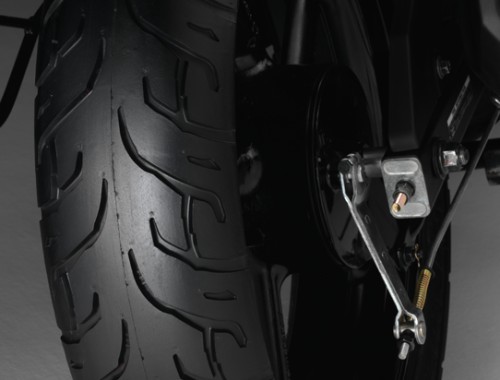
We asked the Yamaha engineers about the actual user benefits that comes from this radial tyre. “The FZ16 has been developed with the aim of going beyond the conventional commuter bike to achieve true sports bike performance that offers the owner real fun of riding. As one of the ways to achieve this goal, we adopted a radial tyre for the excellent firmness it provides. To optimize, the balance between the tyres and the frame, we also adopted an extra sturdy front fork with thick 41mm diameter inner tubes.” We began by asking about more detail on the merits of a radial tyre. “Because of its excellent rigidity, a radial tyre can be designed with less tyre height. And because the tyre is thinner and flatter, it weighs less. The size of the radial tyre on the FZ16 is 140/60-R17, compared to an equivalent 120/70-17 bias tyre. And, although it has roughly the same diameter, it weighs less than the biastyre. This also means lower inertial mass at the rear axle. You might compare this to the feeling of wearing light sneakers as opposed to heavy shoes.
Another benefit of radial tyres is that their added firmness means that even a fatter tyre provides a firm ride with a sharp handling response. Generally speaking, a fatter tyre tends to flex under pressure and therefore does not give a sharp handling feeling. But a radial tyres inherent firmness means that even a fatter tyre there is a quicker convergence of external forces, which means sharper handling and a sportier, more agile ride. It is a tyre that provides a solid feeling of road contact.
To develop the radial rear tyre for the FZ16, Yamaha’s design staff worked closely with the technical staff of the tyre maker MRF and exchanged information numerous times about the exact performance qualities they wanted for this model. The specifications of a custom designed tyre like this involves more than just the various size dimensions. This also involves longitudinal and lateral rigidity balance, grip qualities and flexing (distortion) characteristics and a mutual balance amongst these various factors. Of course, it is not this tyre alone that gives a bike like the FZ16 a sporty, agile ride. Adjustment of the specs of the various chassis components to achieve an optimum mix is also necessary to bring out the maximum performance potential. Here is what the Yamaha engineers had to say about the chassis development: “The FZ16 frame is a newly developed diamond type frame. Viewed externally, it may look similar to the frame of the Yamaha Gladiator, but in fact it is completely different and was developed wfth a prime focus on reducing weight. Also, rigid mounts were used instead of rubber mounts in a design that makes the engine function as a structural member of the frame.
Then we worked on achieving the best specs for the many related parts and components in detail, through repeated tests. The stay that holds the engine (cylinder) head to the frame are made of steel plate with a thickness of 3.2 mm and high-rigidity die-cast Aluminum was used for the parts that connect the pivot assembly to the frame. These parts are especially effective in providing quicker convergence (absorption) of external forces when running at higher speeds. Also, a hard rubber close in consistency to plastic resin is used for the rear hub damper to increase rigidity. This combines with the effect of the rear radial tyre to make this a machine that achieves excellent response to the rider’s handling actions.
In simple terms, you won’t feel any “sloppiness” in the handling response while riding through traffic on the city streets. Instead, you get a response that enables agile riding. The FZ16 has a chassis performance that provides direct response to the rider’s throttle work, and at Yamaha we call this, “drivability with a feeling of directness.” And it is part of their definition of the fun of riding that they want this model to deliver. Another important chassis feature of this model is the extra sturdy front fork with thick 4lmm-daimeter tubes. The 41mm inner tubes of this front suspension are the size usually used on 400cc class sport bikes. Why did Yamaha choose such a high-spec unit? “Besides, its shock-absorbing function, the front fork is also a component that determines the overall rigidity of a motorcycles chassis. To achieve the optimum balance with the new frame and the radial rear tyre, we chose a unit with 41mm tubes to achieve a high level of rigidity.
In addition to providing good rigidity and stability in straight-line running, it also functions especially well to give a good, solid feeling of machine stability on rough roads with continuing bumps and during sharp braking,” the Yamaha engineers comment. That’s not to mention the distinctive look it gives to the bike’s appearance. And, the larger spec also improves the fork’s suspension function. “These thick inner tubes improve the mechanical functioning of the suspension. If you have two suspension units with the same cushioning capacity, the one with the larger inner tube circumference will function better, because the increased surface area reduces the friction per unit of surface area and thus produces better response. Of course, the larger diameter also means that you can give it a larger diameter spring as well. With the FZ16s front fork you wont feel any “bottoming out” when going over bumps or during sudden braking because of the strong, solid cushioning function it delivers”.
The fatter fork may look heavier but that is only the visual impression. “This fork uses tubes with thinner walls to reduce weight, and the handlebar crown that supports the fork is also a lightweight cast Aluminum unit. The design of the ribs on the inside of this crown was also optimized by conducting repeated tests. The specs of the fork offset, caster and trail were also optimized in relation to each other to help contribute further to the enjoyable and highly stable handling feeling”. Another characteristic you will notice with the handlebar crown and the under-bracket on the FZ16 is the wider breadth of their span. They are about 10mm wider than those on the Gladiator and this surely contributes to the stability of the front assembly.
Share on Facebook

{ 38 comments… read them below or add one }
good article…
are such radials available for my P-180….
and which brand of engine oil do you recommend?
Very informative article. Does n’t the Pulsar 220 and the Yamaha R15 also use radial tyres?
Thanks for such a good article
good article..
i do would like t pi\oint out that honda was perhap eh first in dia to use a monoshock suspension
1 thing that has not been discussed over here is that with a monoshock, the problem of synchronising the 2 shock absorbers is eliminated adding to the feeling of rigidity.
ppl will notice this if they have changed over fronm dual suspension to monosuspension!!
either ways an informative article?
can we have more of these regarding the air filters and engine oils??
Ya sure, I will soon come up with some good info on filters and oils.
Hi,
I had purchased this bike 45 days a go, i have a problem with these radial tyre i feel there is air leakeage and i had given it for service also but of no use, can u tell me optimum air pressure for radial tyres.
As per the manual and my dealer, it should be 35 for back tyre and 28 for front tyre.
Hey Ashok, I did some search online but was not able to find the numbers. May be you can call your dealer and ask him.
Hello!
Thanks for the amazing article about the radial Tyre.
Well,i own a Pulsar 220 for almost a year now. My tires are running over and i would like to replace them with radial tyre 140/60-17 rear and the front Tyre both from Yamaha FZ-16. Is it possible to fit with the same rim size?
Will it jeopardize the power of the bike when riding with pillion?
Thanks!
Is there any one who supply tyre of size 130/60, low profile for my Yamaha R 15?
Thank you
hi deepak!
the optimum tyre pressure for the radial tyres for FZ16 is
rear: 33psi
front:28 psi
for any other queries pls free to contact me…
naveen yadav
naveen.neevan@gmail.com
Hello everyone!
I have fitted my P220 with the yamaha radial tyres….the bike looks awesome but the tyre looks a bit thinner compare to the yamaha due to P220′s thinner rim.
The bike also have better leaning angle but theirs a decrease in drastic initial acceleration which is unnoticeable during normal driving unless your on track.
That’s all from my point of view.
I just want to ask you guys….
when the tyre needs to get it replaced will I have to change the whole wheel.. is it casted or I can change the tyre only…
Hey guys,
Can I fit the swing arm and the rim of FZ 16 in my Yamaha R15 so that I can fit the FZ tyre in it?
Thanz
Hi,
Can I replace the rear wheel of Gladiator SS with this radial tyre??
Definitely can be fitted without any alteration.
But remember your changing its originality.
Eric Reuben MRF LTD
Thanks for posting such a good article on radial tyres. Are radial tyres custom made always for particular bike model? Does MRF manufactures radial tyres for Honda Unicorn also?
I purchase a Hero Honda Hunk one month ago. I want to use radial tyre. Which company’s tyre I should buy and what size? Will I need to change wheel rims then what size?
Hi Deepak,
I have 40days old Fazer. It also use same radial tyre.
I also face the same problem like Ashok.
I have no clue how the air go out from both tyres.
Yamaha Recommended value:
Front: 28
Rear: 33
I filled the same amount of air.
But after 7days when I check then I get:
Front: 22 (-6)
Rear: 28 (-5)
Not only me one of my friend also have the same problem with his FZ16
PLEASE HELP ME WITH RIGHT INFO. Thanks in advance
I owned Fazer too. From my personal experience , from my friends and other fazer owner, I heard it is standard problem with tyre pressure. Tyre quality may be questionable???
I olso faced dis kinda problm in ma FZ-16.. Then i tink 2 increase d pressure.
Front: 28psi
Rear: 37-38psi
Nd now dhre z no sch probx.. Cheers.. Happy ridin. ^
Same question as “dex”, but I have a zmr? Could i use an fz-16′s tyres??
Hi,
i own a p-200 and use nitrogen air for my tyres,i think those guys who had problems in their fz’s n fazer can give a try of changing from normal air to nitrogen air for there tyres,its really good and it gives more stability.any bike can fill nitrogen air,so why dont u guys give atry and feel the difference…
YAMAHA FZ-16 says: ofcourse nitrogen air is good for me but my rear tyre sucks ass.
fill helium, fill hydrogen, or even fill some poison.
i will still leak cause i have periods every week.
seriously…
i own a FZ-16, i have changed my rear tyre from MRF twice. But punctures still haunt me and i doubt they will stop haunting me.
I will have to get rid of this cursed MRF 140/60 tyre and pick up some real good quality stuff.
also, i just changed my rear tyre and i filled nitrogen air in it.
One puncture and my 30 buck nitrogen air has dissolved in thin air.
i have spent 1200 in replacing two tyres from MRF in one year.
And these punctures will amaze you because the tiniest and laughable object manages to get through this soft rubbered MRF tyre.
It may not be MRF’s fault, it is Yamaha’s fault to commission such a sad ass tyre for such an awesome bike.
It’s only the rear tyre where they fail big time.
Assholes should have done some real road testing instead of launching this sexy bike in such a hurry.
but Bazz… you will not understand until you own a Fazer or FZ. It is not nitrogen air, it is this sad ass tyre.
Yamaha knows it, MRF knows it.
My suggestion to MRF is that they design a new tyre (as one DM told me MRF was doing but i guess that was a on-the-face lie) instead of replacing 20-25 tyres every month (as they are currently doing)
take compensation, some of us dont mind.
all we want is peace of mind.
I NEED A OWNER MANUEL FOR MY FZ16 IN ENGLISH…CAN YOU HELP ME?
hiiiii
i have fzs16 black n yellow but i want to change yellow into white
so do yamaha provides orignal stiker which r on yellow paint
hiiii
how much it would cost to custom paint for fzs16 black n yellow into white
only yellow part n rear wheel only
Hi Guys,
What will u say if Yamaha become technical partner of HERO Group………….?
this information helps me a lot to decide y i need to buy fz16.
i have bike for yamaha fz 16…….. so i want to refully the breez from back and front tyres i dont no how much brez want to inssert pale help me
I want a yamaha FZ rear tyre for my Honda Stunner CBF?How much it gonna cost me (with RIM)in India and where I can buy it(in NCR)?
I have yamaha fzs and have the same problem as above cited by different users about rear tyre. I want to change that bloody MRF 140/60 R17 tyre with another company’s tyre with enhanced height (more than 60). Dear friends, can anyone of you tell me that Is there any tyre of this type in other companies. If it is please do tell me.
Thanks.
what is the ideal tire inflation pressure for a rainy day?
im scared to bank on a curve coz i dont really trust the stock tire, but maybe with the right inflation iLL learn to test it =)
FZ rear tyre = puncture every week.
Due to this, I had to make my mechanic add a tube inside it. It did help, but I feel I dont have the same grip anymore.
The tube I have had to use is of a different dimension, since MRF apparently does not manufacture tubes appropriate to the 140/60 tyre.
Any suggestions?
The Worst tyre one could have , my bike done 11,000 KMS with 5 Punctures so far , and one side entire tyre was gone and the threads came out . When i checked with the service center , All they say is , Yes there is a problem with the tyre , but no claims are replacement ..WTF !!!
Guys can we replace cb twister rear tyres by yamaha fz radial tyres
I want to change ma fz-1 tyre can u send a mehenic at ma placeee hahahaha just jokin broo
good articlee hatss offf nn thxxxx
hi, friend
i’m chaging my fzs rear tyre from P-220 rear tyre
is it good or not
give some suggustion